

Is Science Partisan?
It Wasn't Always; With GOP Attacks on Intelligence and Academia, It May Now Be.

Let’s get this out of the way right away; “Science,” in and of itself, is not partisan. Science represents a certain methodology and process, not necessarily a political mindset. If someone has a hypothesis, formulates a study, conducts unbiased reseach and produces applicable rational and logical conclusions resulting from the study, that is not a partisan endeavor.1 What others perceive in the results or do in application—that CAN be very partisan.
Quite often our perceptions of whether a study is “right” or “wrong” come from our own perceptions and biases. If the study reaffirms what we believe we tend to be more accepting of the results, and when people disagree with the results and conclusions presented, we tend to find errors. That is one of the reasons scientific study is rarely a “one-off”; what makes science a true finder of truth is that anyone can take what was done previously and replicate the study accordingly. If the process is sound, the methodology suited for the goal and the reasearch done without bias, the results should be the same. Likewise, if the conclusions are to be relied upon, if they are assumed for future studies and people find a different result accordingly, they can be subsequently DISPROVED.
A great example of this is Robert Millikan. He was the eminent physical sciences scientist in the early 20th century. In 1905, an unknown patent clerk wrote an article about the “photoelectric effect,” questioning the idea that light was solely a wave—that it actually was more like a particle that sometimes traveled in waves. In particular:
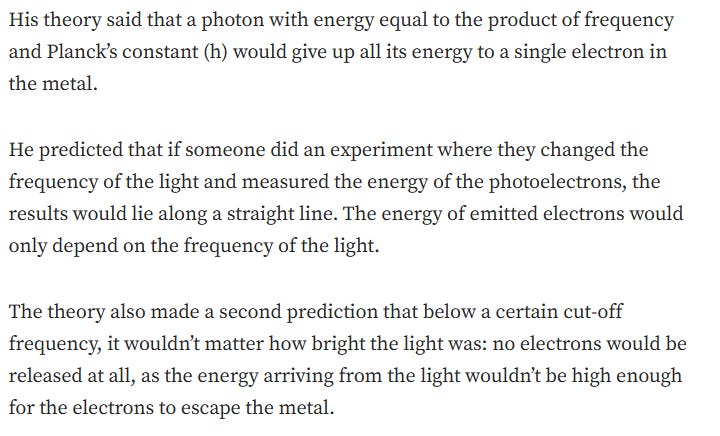
The scientific community scoffed at the article and thought it stupid and naive. Robert Millikan, a complete skeptic to the idea2, took the next step and went about trying to disprove it. He designed a methodology and an experiment, tested it out, and what occurred shocked him— every test CONFIRMED the results of the article by the clerk. After many years of experiments, he finally published his result and proved that that obscure author was right all along. Every prediction turned out to be supported. Although he accepted the experimental results, he was still in disbelief about the implications of his findings. As a result of all of this, that clerk, Albert Einstein received the 1921 Nobel Prize, and some years later Millkan would receive the Nobel for his experiments proving it. SCIENCE!
Where things get dicey is where the implications of research impacts various business interests:
Clair Patterson proving the hazards of leaded gasoline, and going up against Standard Oil.
The American Lung Association going against “Big Tobacco.”
Various groups going against the NRA and the gun lobby.
What all of those three have in common is that those business interests were largely seen as Republican business interests, and partisan attacks. That Big Tobacco created it’s own institute, to fund research that spun tobacco in a positive light in order to counter allegations against it just worked to muddy the waters and the research. Despite how reliable academic research was, big business pushed back.
Academia and Politics
Academics fund their research in two major ways:
Through associations with colleges and universities who foot the bill through their own finances (alumni, donations, taxes, etc.)
Grant money paid from various entities and non-profits, largely for philanthropic enterprises.3
And academics tend to be insulated from the factors within the private sector that usually drive innovation. They have tenure, they have labs and resources, they have institutional prestige. Because such jobs are driven by public sector funding (taxpayer dollars), they tend to be more liberal as well.4
During the late ‘60s and early ‘70s, Richard Nixon took a distinct dislike into academia—specifically, Ivy League academics. At the time, students were vehemently against the war, and many went to college for deferments to the military draft. Colleges became incubators for more liberal thought and partisan electoral canvassing. During the Reagan years, this subsided a bit as the drive to go to college was replaced less by avoiding Vietnam and more by monetary gains. Being taught by a well-respected Professor, regardless of persuasion, became an elite opportunity. And so it went.
With Trump though, he took the war against colleges and made it a plank in an overarching platform. The result?—less people have faith in academic institutions than at any point in the last 100 years. Less people agree with expertise and those with higher degrees than at any point since polling began. Less people believe in foundational academic research studies and are more likely to find them as unsupported, than at any time since polling began. On top of this, more people believe in conspiracy theories and false information than ever before. Trump went to war against thinking and is winning. His supporters now disagree more often with people who know what they are doing in their respective fields more often than they agree with these experts.
And it has been effective. Academics, often by nature condescending and conceited when it comes to their intellectual prowess, are often not as well liked among people particularly working in the private sector or who didn’t go to college. There is a tendency, even among academics within academic circles, to assume themselves arrogantly right to the detriment of others, some of whom are openly trying to prove them wrong.
As with so much of Trump’s proposed policies, they can be distilled down to a series of “if/then” statements, themselves predictable based on just general research studies:
If Trump pulls out of the Iran Deal, Iran will work towards a nuclear bomb. Quell surprise!
If Trump’s tax bill passes, the deficit will jump to almost $2 trillion a year. By 2020, it was at $4 trillion, largely due to economic issues related to COVID.
If Trump throws out the idea of using hydrochloroquine or Ivermectin (a horse tranquilizer) as a remedy to COVID (against the scientific research that proved it ineffective), people will buy it up in droves. They did. It didn’t work.
But with Trump taking an active role in attacking some of the genuinely smartest scientific minds in America in 2016, for the first time ever scholarly academic journals started writing endorsements of his opponents. Among the major reasons:
The elevation by Trump of conspiracy theories and disproven data.
Trumps advocacy for gutting funding to schools for academic research and elimination of the Department of Education.
Trump’s plan to eliminate funding for the NIH, CDC and FDA, all key agencies that conduct health research to keep the nation safe from infectious diseases and improve public health.
Trump’s appointments of incompetent and disgraced individuals who were not considered qualified for the scientific positions they held in the public trust.
Trump’s continued advocacy for anti-vaccine rhetoric.
When COVID hit, much of these chickens came home to roost. The most reliable and visible figures in the administration who demonstrated the most authority were Dr. Anthony Fauci (head of the NIH) and Dr. Deborah Birx (former director of the CDC and on the President’s Health Council). Their advice throughout the pandemic was strongly relied on by the public. When Trump lost and as the shutdown continued into a second year, Trump and Republicans put the blame on them and hung it around their necks.
Trump’s war against science has only increased in his second term. Practically nothing in this term is being done based on rational thought or sound logic; it’s all being done impulsively, often contrary to the facts on the ground, based on pure emotional decision-making. To be fair, that’s not always a bad thing; however, in a risk averse position like the Presidency where things can go really wrong, really fast for really a lot of people by working that way, it’s not the ideal way to manage a country. When people who know better speak out against Trump, he pivots to the idea that “of course they’re snobby liberal academics” and “Trump knows better” which further undermines credibility in sound research. When Nature and Scientific American endorsed Kamala Harris in 2024, it was kind of a no-brainer, but it spoke to nobody outside of people already inclined to vote for her. Nature and Scientific American did themselves no favors and are now looked at by many as partisan publications as a result.
Which brings us to where we are today. We have one party consciously choosing to be “know-nothings” following an imbecile with a Napoleon Complex who thinks he’s smarter than anyone else5, including experts in their fields. And then we have the other party, smug in their strong belief that they are always right, and the more they go about proving it, the more unlikeable they become. The more Democrats/academics/other people shout out (correctly) what the right course should be, the more the other side pushes back, almost in revulsion to those brain-y individuals who look down on them.6 It’s a bit of a paradox. For most people, intelligent and rational enough to understand what’s going on, the question becomes whether they want to use their heads or follow the partisan backlash against sound judgment and intellect.
So long as conducted without bias. One of the issues with every scientific study is that it takes on many of the biases of the person conducting the research, or the people funding it.
He considered Einstein’s idea to be preposterous and believed that a little tweak in classical wave theory will explain the photoelectric effect.
The competition for grant funding can be particularly fierce. Often there are hundreds or even thousands of applications for only a handful of grants.
And I want to be clear here—just being in the public sector does not make one liberal. It’s just being insulated by private sector concerns, tends to make one more idealistic. It’s easy to have high minds about something when you don’t have cares about who pays the bill.
“I passed a Cognitive Test! I think all presidential candidates should have to.”—Donald Trump earlier this month.
To be fair, if you are presented with evidence of something, and reject it just because you don’t like who delivered the accurate reporting, you deserve to be looked down on.