

Democrats' Problems in a Nutshell
The Minnesota Senate Race is a Microcosm of the Issues Facing Democrats

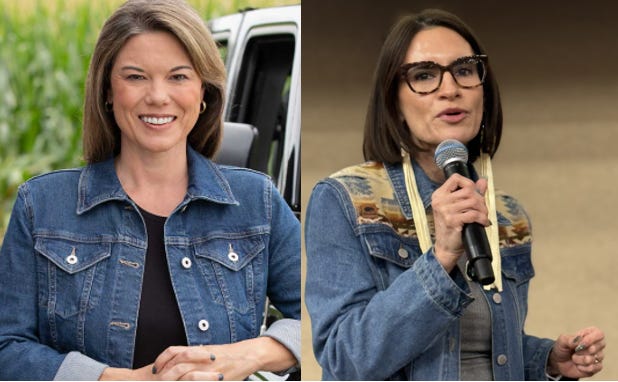
Democrats have a real problem on their hands.
2026 is going to be a big Democratic year. The wave is already growing, the energy is already building and it has been a very good recruiting year for the party on getting candidates to run. Nonetheless, there is a growing divide in the party between the progressive and the practical, the further left vrs. the broader spectrum, the ones who want a governing majority to be as progressive as possible against the ones that want to build up a broad based governing majority that will last a decade or more. In short, its a fight for the short term vrs. long term visions.
These are tough questions, and no state better encapsulates the issues with this than the Minnesota Senate Primary for the Democratic Party.1 There are several candidates running, but the two who have the best opportunities to win are current Congressional District MN-2 House Member Angie Craig, and current Lt. Governor Peggy Flanagan.
I’ll spare you what each candidate says they are running for, because we all know its a bunch of hokum anyway. But in a nutshell, it works out like this; Craig, a former executive for Medtronic (medical devices), a moderate, representing a moderate suburban district, is running against Flanagan, a very progressive, identity politics driven, urban cosmopolitan liberal. Or to put it even more bluntly, its about pragmatic moderation versus partisan liberalism.
To be sure, the Democrat IS going to win this race. The GOP candidate is former ESPN sideline reporter Michelle Tafoya, who is well known in Republican circles in Minnesota. She makes the rounds on Newsmax, FOX, and other GOP outlets spewing typical right wing logorrhea. She has potential to keep many male voters who remember her from her sideline reporting days, but she’s not going to win over much of anyone else. Think Kari Lake of the Midwest. It’s very much a blue year, Minnesota is a lean blue state, and all indicators are barring some catastrophe, the blue candidate will win.
But it’s not just a campaign about issues, its about personal appeals and management styles.
Craig, a lesbian who has adopted sons, tends to downplay LGBT issues in favor of a more “family values” approach and focus on other “bread and butter” issues. She’s open and honest about her family, but it’s not central to who she is as a candidate. Flanagan tends to reiterate and rebroadcast and re-appeal to every identity group imagineable. She regularly makes nods to the LGBTQIA+ community, she’s a member of Minnesota Native American Tribe and is eager to throw out words in their language from time to time, she is a strong advocate for minority groups (including the local Somali/East African population, the Hmong community and Muslim groups). To Flanagan, identity politics IS her brand.
Looking at the NYT website, a recent poll shows Flanagan currently comfortably in the lead. However, on closer inspection, three things stand out; 1) MOST of the polls to date have been funded by Flanagan’s campaign, 2) she doesn not have a majority vote yet, and 3) a lot of Democratic voters are yet to make up their minds. The number of polls the Flanagan campaign has done so far is a bit concerning; it’s emblematic of a more consultant driven campaign rather than a grassroots oriented one. Polls are costly and at this point in a campaign, unncessary. Better to spend money on building up the organization.
Craig raised $2.5 million in the first quarter of the year, according to Federal Elections Commission filings, besting Flanagan’s haul of $1.3 million. That sets up Craig with $4.8 million in cash on hand, more than the $1.1 million Flanagan has in the bank. Flanagan’s filing also shows her burning money at a rapid rate: Her campaign spent more than $1 million in the first quarter, nearly as much as it raised. (Source: Politico)
Flanagan’s base of voters are the urban centers of Minneapolis and St. Paul. These voters tend to be very progressive in approach, particularly those areas associated with the University of Minnesota. Craig’s House district is in the southern suburbs, which tends to be a little more conservative (it was held by a Republican member until Craig won in 2018). Craig’s record in the House is more bipartisan, ranking in the top 10-15% depending on which group does the ranking.
A good way to compare these are to point out the two sides of Governor Tim Walz’s career. As a House Member from the rural Southern MN-1 district, Walz was a moderate. That’s similar to where Craig is. After being elected to the Governorship and running as Vice President for Kamala Harris, he notably swung left; he didn’t go as far left as Peggy Flanagan, but that’s the group of voters she is working to appeal to.
I’ll add too that Minnesota is very much like Wisconsin in this regard, and the comments I made here. But there is one big difference politically between the two states; there are a LOT of Democratic voters in outstate Minnesota. This goes back to the old Democratic-Farmer-Labor (DFL) roots of the party, and whereas rural Dems withered elsewhere, they still exist in Minnesota. Up on the Iron Range in the North (Duluth) down in the southern farm country (centered on Rochester) and in the western farms Represented by Colin Peterson for decades. Democratic voters are throughout the state and still relatively well organized. This is NOT just an urban/rural divide state as others so often are.
I live in Minnesota (in Craig’s district) and talk politics with a lot of people all over the political spectrum. In a very unscientific and anecdotal way, I can kind of describe it this way:
To long time Democrats, particularly the activist base, Flanagan is very popular. These voters WILL show up in a primary election.
To more passive Democrats, moderate and non-partisan voters, Craig is a much more appealing candidate. This group is quantifiably larger than the Democratic activist base, but is much less reliable to vote in primaries.
So why does this matter? Well, it’s a big indicator of the direction the Democratic Party is going to go in the coming years. If the Democrats can win more districts coast to coast with more moderate candidates, they stand a chance for making a long term durable coalition that isn’t so focused on metropolitan and coastal areas. That puts more states and more House districts in play, just as census redistricting occurs in 2030. If on the other hand, more progressive candidates win, they may get a short term coalition, but it will be very progressive, alienate many, and result in long term problems. Dems can no longer rely on the Blue Wall to get or maintain the White House, which means they have to compete more broadly. The power within the party is still in those Dem-Centric areas in NY, CA, and urban areas anethema to most in the middle of the country. It’s practically inconceivable the Democratic Party as it currently is constructed could win the White House with the coalition it had in 2020.
Following the 2024 disaster for Dems, in hindsight, many criticized the left’s overfocus on wokism, identity politics and consultant driven demographic groups rather than outreach to voters and advocating issues they found important. Here we have an election that is very much along those same lines. Worse yet, it’s being driven by the candidate directly appealing to the most activist Democratic voters in the same way they did in 2024. However, the money, which is always a sign of where the party heads WANT the party to go, is on the other side of the equation. It’s a real conundrum for Democrats. Whoever wins these elections are going to be setting the narrative for the 2028 Presidential Election Campaigns as candidates start debating and jockeying for position in 2027.
It’s an issue that DNC Chair Ken Martin will have to think over carefully. Oh, did I mention Martin is from Minnesota and the former head of the Democratic Party here? Now you know.
In Minnesota, the Democratic Party is the DFL (Democratic-Farmer-Labor) Party. For the ease of consistency, we’ll just call it the Democratic Party in this piece.
It is fair to say I am completely alienated.
Lots of calls to accept the socialists. Fuck them.
Excellent analysis…I am not a Democrat. I lived in Portland and gave up on the party after the 2020/2021 and the debacle that was Joe Biden. That said I am worried for the party.
They are driving moderates to places like Florida, Texas, and a number of other red states.
This will create three big problems. First it worsen an already bad map, creating perhaps a dozen more red leaning seats for hose republicans. Second, after the shit show that is Donald Trump they may end up facing a more moderate and competent Republican Party.
Third, if the Dems manage to win in 2028 they will also kind of own the train wreck that coming.
I think the Dems really need to moderate just to stay in the race. It doesn’t need to be extreme because they party has moved so far least since Obama in 2008. Just adopt an stance comparable to Obama 2012 and try to focus on rejuvenating the state Dem parties in red states.
The problem is that Dems or dem leaning people who moved to red states will not trust the party if the national brand does not change. The party needs to moderate enough to make those voters (I.e., the ones who moved to get away but are still fundamentally at least slightly left) feel like the won’t get screwed again.
If the current party can’t move enough to the right in the face of Trump, I have doubts about their ability to do this now.